
Progesterone is, of course, very important to our hormonal health and reproductive system. It is one of the hormones that play a vital role in regulating many of the body’s functions – especially a woman’s menstrual cycle. It also plays a very large role in maintaining a pregnancy, so having low levels can contribute to miscarriage. Symptoms of low progesterone contribute range from increased PMS to allergies!
During the luteal phase of the menstrual cycle, progesterone is produced by the collapsed follicle after ovulation until either the period begins or pregnancy takes place and the placenta takes over for producing the progesterone.
“One of progesterone’s most important functions is to cause the endometrium to secrete special proteins during the second half of the menstrual cycle, preparing it to receive and nourish an implanted fertilized egg. If implantation does not occur, estrogen and progesterone levels drop, the endometrium breaks down and menstruation occurs.
If a pregnancy occurs, progesterone is produced in the placenta, and levels remain elevated throughout the pregnancy. The combination of high estrogen and progesterone levels suppress further ovulation during pregnancy. Progesterone also encourages the growth of milk-producing glands in the breast during pregnancy.” 1
Other Progesterone Roles in the Body
- helps normalize blood sugar levels
- boosts thyroid function
- helps us use fat for energy
- has beneficial anti-inflammatory effects
- reduces swelling and inflammation
(from the book What Your Doctor May Not Tell You About Premenopause2)
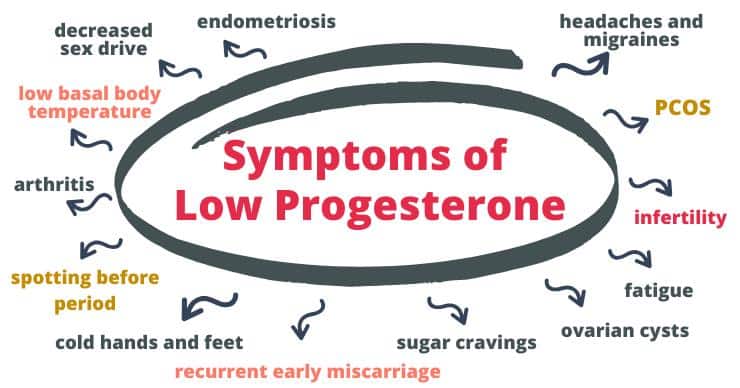
Symptoms of Low Progesterone
Many of the symptoms of low progesterone also coincide with symptoms of other health issues, so be aware that just because you may have some of these, it doesn’t mean you have low progesterone, just that it’s something worth looking into and having tested.
- a luteal phase less than 12 days (read here to find out what a luteal phase is)
- sugar cravings
- ovarian cysts
- low basal body temperatures
- irregular periods
- allergy symptoms
- arthritis
- brown spotting in the days before your period begins
- recurrent early miscarriage
- blood clots during menstruation
- cold hands and feet
- brittle nails
- cracked heels
- decreased sex drive
- menstrual cramps
- depression or anxiety
- acne
- fatigue
- fibrocystic breasts
- PCOS
- endometriosis
- fibromyalgia
- gallbladder issues
- foggy thinking
- headaches and migraines
- infertility
- vaginal dryness
- slow metabolism
- mood swings
- weight gain, especially around the middle
I highly recommend the book What Your Doctor May Not Tell You About Premenopause by Dr. John Lee to anyone needing to know more about natural hormone balance. He discusses at length why we may be low in progesterone and how to use natural progesterone cream to help rectify the issue.
Notes from What Your Doctor May Not Tell You About Premenopause
-
- Xeno-estrogens/xeno-hormones make us estrogen dominant. They come from plastics, synthetic hormones, conventional meats, and animal products, etc. This exposure can result in low progesterone. When mothers are exposed to it, it can even cause dysfunction in their daughter’s ovarian follicles!
- The embryonic stage of life is when ovarian tissues are most sensitive to the toxicity of xeno-hormones
- Xeno-hormones are fat-soluble (meaning the body absorbs and holds on to them) and non-biodegradable
- Stress increases levels of cortisol, which blocks progesterone from its receptors in the body. Too much stress and progesterone won’t get where it needs to go.
- Using huge amounts of supplements over the long-term may result in another imbalance in the body.
- Our bodies release mood and energy enhancing chemicals (like adrenaline) to fight allergic responses to food – we are hooked on what we’re allergic to!
- Exercising too hard lowers antioxidant levels in the body. Moderate exercise raises levels.
This book also went into the explanation of natural progesterone creams, which aren’t truly “natural”; a better name is bio-identical. You see, the progesterone in our bodies is produced nowhere else in nature. Dioscorea mexicana is a plant that is part of the yam family native to Mexico. It has a steroid compound called diosgenin that is taken from the plant and is converted into progesterone by changing the cellular structure to match our natural progesterone.
How to Test Your Progesterone Levels
If you find that you have many symptoms of low progesterone, the best way to figure it out is to begin charting your menstrual cycle. You will be able to see how long the second half of your cycle is and if less than 12 days it’s a fairly sure bet that you aren’t producing the amount of progesterone you really need! (Click here to learn how to begin charting)
For confirmation, you can ask your doctor to have your progesterone levels checked on the seventh day after you ovulate. This is when progesterone levels usually reach their peak during any given cycle.
Many doctors will have you get your lab test done on day 21 of your cycle…but if you don’t ovulate on day 14 the results will be off. You need to know when you ovulate for the best results! Some Reproductive Endocrinologists actually test progesterone levels multiple times during the cycle when progesterone is chronically low or even after trying to boost it naturally and using supplementation.
Most doctors consider progesterone levels between 10-20 ng/mL at 7 days past ovulation as normal. If they are below 10 it means you may not have ovulated (anovulatory cycles create low progesterone), that maybe you miscalculated your day of ovulation, or it could mean that progesterone production is very low.
While progesterone levels may vary depending on when blood was drawn (they can vary even during the same day), it will be a good indicator of what may be going on with hormone production.

How to Naturally Increase Progesterone
1. Make Sure Your Diet Includes Cholesterol
Progesterone, like all other steroid hormones, is synthesized from pregnenolone, which in turn is derived from cholesterol3 so making sure you have adequate consumption of dietary cholesterol is very important. You don’t have to go nuts, but if you are currently on a low-fat diet you may want to consider using butter, olive oil, or coconut oil instead of margarine products.
2. Herbs to Boost Progesterone
- Vitex may be helpful as it works to lower estrogen and raise progesterone simultaneously. However, not every woman responds to vitex (also known as chaste berry) this way so please consult an herbalist before you begin taking it. (learn expert advice from a fertility practitioner about vitex here)
- Turmeric, often found in curry, is known to help increase the body’s progesterone levels. You can also make a lovely warm drink, often referred to as golden milk, for getting turmeric into your diet.
- Thyme and oregano are thought to have many of the same properties as turmeric and can be included in many recipes throughout the week.4
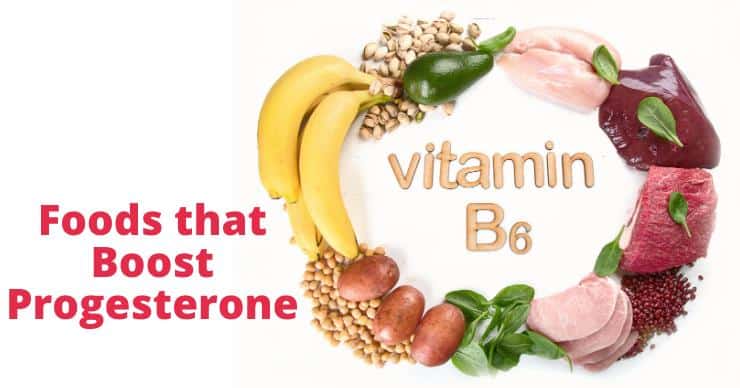
3. Eat Foods Rich in Vitamin B, especially B6.
Can foods help boost progesterone? Absolutely!
Vitamin B6 is a specific nutrient that is essential for the development of the corpus luteum (the collapsed follicle after an egg is released that produces progesterone in the second half of the cycle). You can find vitamin B6 in many foods including;
- grass-fed meats
- whole grains
- wild-caught tuna
- chicken
- spinach
- sweet potato
- bananas
Make sure to consume foods high in different forms of vitamin B, or supplement with a vitamin B complex, as these vitamins work best when they work together!
4. Choose Organic, Preferably Grass-fed, Meat and Dairy
There is a possibility that conventional beef may come from animals that have been given growth hormones, and while our bodies may have a response to all animal hormones, these, in particular, may act as estrogens in the body. The higher your body thinks your estrogen is, the more of a chance your progesterone levels will be suppressed. Grass-fed meats also tend to have lower fat in general, but higher quantities of Omega 3 fats.5 Grass-fed animal products also tend to have higher levels of Vitamins A and E6, both nutrients helpful for fertility.
5. Reduce Exposure to Xeno-estrogens
These estrogen-like compounds are found throughout industrialized countries causing problems for hormone balance in both women AND men. Some studies have even shown that they are changing our wildlife (feminized male fish in certain waterways). 7
A few simple tips:
- don’t use plastic to store your food,
- use frozen instead of canned foods,
- stop using conventional cleaners, and
- switch to natural beauty products.

6. Ensure Adequate Magnesium Intake
This mineral helps to boost progesterone production by simply calming the nervous system and regulating the HPA axis (hypothalamic–pituitary–adrenal axis, which affects hormone production). 8 as well as by assisting in the breakdown of estrogen. You can also find magnesium in foods like beans, lentils, leafy greens, almonds, and pumpkin seeds.
There are many different forms of magnesium, but Magnesium glycinate is gentle on the stomach (not as likely to cause diarrhea) and as an added bonus, it may also help with insulin sensitivity. I’ve also personally used magnesium oil transdermally and often use the drink mix Nature Calm (available on Amazon).
7. Eat Protein with Every Meal
Hormones need protein for production and as an added benefit it also keeps you feeling satisfied and reduces blood sugar spikes after you eat. You can choose both animal-based proteins like meat and eggs or plant-based protein like beans and nuts.
8. Practice Lunaception to Boost Progesterone
In its simplicity, lunception is the practice of sleeping in total darkness all but 3 days out of the cycle. Simply make sure your window is completely covered, where no light can get through, and eliminate electronics that have any sort of light on them. During the 3 days surrounding ovulation, you can either open the curtains or sleep with a small nightlight, simulating a full moon. Kate Singer, in her book Garden of Fertility, states that this strengthens progesterone production.

9. Take Care of Your Adrenal Glands and Lower Stress Levels
When it comes to stress and hormones, it all starts in the brain! I follow a few hormone experts on Instagram, and Dr. Carrie Jones really hit it out of the ballpark with the following explanation on how stress causes cycle and hormone changes.
“The brain tells your ovarian theca cells to make testosterone. This aromatizes into estridiol in the granulosa cells. Once you ovulate, these cells become lutein cells (corpus luteum) and they pump out happy progesterone!
However, stress-causing too much cortisol and norepi/epi can block this in your brain!
Aromatase is an enzyme made by the CYP19a1 synapse. In your brain, there is a “promoter’ that is increased by cortisol causing an increase in aromatase production resulting in more estradiol (E2).
High E2 in your hypothalamus causes suppression of the GnRH signal therefore your pituitary can’t make healthy levels of LH and FSH.
Without FSH or LH you can’t properly choose an egg to grow and ovulate so now circulating estradiol or progesterone levels drop. Many women might even skip a period or get a weird late period.”
-Dr. Carrie Jones ND MPH, medical director of DUTCH Test
Working to reduce stress allows the body to come out of its fight or flight response and begin using its hormones properly for reproduction. The cycle changes are basically the body crying out that something is wrong!
Stress is probably the biggest cause of low progesterone. This can be due to nutritional stress (not eating enough/not eating enough nutrients), emotional stress, or physical stress.
10. Use a Bio-identical Progesterone Cream
If you have major problems with estrogen dominance which is preventing ovulation, or you’ve worked to increase your progesterone levels naturally for a few months with limited success, you may want to talk to your healthcare provider about using a bio-identical progesterone cream or suppository. It’s not a “fix-all”, but may help in the short-term as you work on boosting levels naturally.
Ways to Supplement Bio-identical Progesterone:
- Low-dose topical creams – found over the counter at health food stores, pharmacies, and even Amazon, these low-dose creams are used transdermally (applied to the skin) and may be helpful for women that have progesterone levels just slightly low. Because it’s applied to the skin it’s different for every woman as to how much her body absorbs. (I used this cream for a few months)
- Oral pills – doctor prescribed, these pills can be found as either bio-identical or synthetic, so talk to your doctor about the version they are writing a prescription for. In my own personal experience taking this form, I’ve found that the pills were not very effective ways for me. It seems the digestive system has to break it down and it gets processed by the liver before being used. It simply made me bloated and did nothing for hormone balance. Some women have had decent results with the pills, so if that’s all your doctor will do it may still be worth trying!
- Vaginal suppositories – this version is most easily absorbed, doctors can write a prescription for bio-identical suppositories which are like easily dissolved pills you insert in your vagina every night. The downfall is that they can be messy, and sometimes you have to visit a specialized compounding pharmacy, but if other versions aren’t working for you it’s worth it to try them.
Don’t use hormone supplementation long-term (unless you are under a health-care professionals guidance!) as you could cause an imbalance with too much in the body. You need to work with a healthcare provider to get your levels tested before using progesterone and begin with a low supplementation dosage and work up as necessary.
The topical cream I have used in the past is from Beeyoutiful. While “all-natural progesterone” is the same no matter what company creates the cream or oil, it’s the other ingredients in it that can make a big difference. Watch out for creams and lotions that contain xeno-estrogens and make sure to check for parabens and phthalates.
Beeyoutiful’s cream contains just coconut oil, jojoba oil, avocado oil, extra virgin olive oil infused with organic wild yam root, organic comfrey root, and cayenne, 1000 mg USP progesterone, sweet orange essential oil, rosemary essential oil, candelilla wax, beeswax. From my limited experience with it, it goes on easily, absorbs quickly, and has no smell.
Final Word
Dealing with low progesterone is frustrating, but it’s important to remember that this system does not act alone, there are often other issues at play. If your doctor is unwilling to run hormone tests or help you get to the root cause try looking for a Functional Doctor, Naturopathic Doctor, FEMM Practitioner, or NaPro practitioner in your area.
Increasing your levels naturally is possible with the right support!
Sources:
- Progesterone. (2019). Retrieved June 01, 2020, from https://www.healthywomen.org/condition/progesterone
- Lee, J. R., Hanley, J., & Hopkins, V. (2005). What your doctor may not tell you about premenopause: Balance your hormones and your life from thirty to fifty. New York: Grand Central Pub. (available on Amazon)
- Progesterone. (2020, April 11). Retrieved June 01, 2020, from https://en.wikipedia.org/wiki/Progesterone
- Symptoms of Low Progesterone Levels – Natural Progesterone Info. (n.d.). Retrieved June 01, 2020, from https://www.nativeremedies.com/ailment/increase-low-progesterone-levels.html
- The heart-health benefits of grass-fed beef. (2019, January 09). Retrieved June 01, 2020, from https://www.mayoclinic.org/diseases-conditions/heart-disease/expert-answers/grass-fed-beef/faq-20058059
- Daley CA;Abbott A;Doyle PS;Nader GA;Larson S;. (2010, March 10). A Review of Fatty Acid Profiles and Antioxidant Content in Grass-Fed and Grain-Fed Beef. Retrieved June 01, 2020, from https://pubmed.ncbi.nlm.nih.gov/20219103/
- Pinto, P., Estêvão, M., & Power, D. (2014, August 15). Effects of estrogens and estrogenic disrupting compounds on fish mineralized tissues. Retrieved June 01, 2020, from https://www.ncbi.nlm.nih.gov/pmc/articles/PMC4145326/
- Boyle, N., Lawton, C., & Dye, L. (2017, April 26). The Effects of Magnesium Supplementation on Subjective Anxiety and Stress-A Systematic Review. Retrieved June 01, 2020, from https://www.ncbi.nlm.nih.gov/pmc/articles/PMC5452159/

Donielle Baker




 Probiotics for fertility
Estrogen Dominance is often a misdiagnosis when it comes to luteal phase dysfunction, WITH the following symptoms or histories:
-short follicular phase – time between end of bleeding and ovulation. This is a sign of low estrogen production in the body. This rolls into having a weak luteal phase because without the estrogen, the progesterone production will be low as well in response.
-history of malnutrition (“dieting”, low carb especially) and/or prolonged strenuous exercise. Google, “Exercise Luteal Phase Defect Amenorrhea”.
Progesterone cream and Vitex may not help in this scenario because of the underlying starvation response in the body. Women need an extra 500+ calories during their luteal phase and this is what causes the cravings. Your body is trying to tell you that you should eat more!
@Anna,
Interesting! It makes sense. Last week I was STARVING and was eating a lot more than I usually eat. I was in the luteal phase. This week I’m not eating as much.
And yes, I have a history of dieting, skipping meals and low-carbing.
@Ann Marie @CHEESESLAVE,
If you think of it, progesterone is “pro-gest”, meaning, your body prepares for possible pregnancy. And pregnancy = more calories to create a placenta, blood supply, and baby. I really liked reading Dr. Tom Brewer & Gail Sfroza Brewer’s writings. Very strong on having ample protein to do all of the above and prevent pre-term labor & pre-eclampsia.
Another interesting tangent is a recently posted TED talk about “what babies learn before birth” or to that effect. The speaker references maternal malnutrition (pre-pregnancy and during) which conditions the child’s metabolism towards diabetes/obesity in later life.
@Anna, I am so interested in the “need an extra 500 calories during the luteal phase”. Do you have any links or other info on this? I’ve recently been looking into the changes that happen between the phases of the cycle and this would totally fit with a couple other things I’ve come across.
@donielle,
Taken from Don Matesz’s acupuncture website:
http://www.barefoot-acupuncture.com/PMS.html
Would be a worthwhile blog post. 🙂
@Anna,
That’s so interesting because I’m always more hungry during that phase! I’ve been taking chaste tree, and I’ve noticed in the last month or so, it’s gotten worse! Does that mean I’m getting more in balance? : )
@Lori,
If you are experiencing depression symptoms as part of your PMS, stop vitex! Henriette’s Herbal page has a post regarding this problem.
As for eating – continue to “Eat the Food”, i.e., eat more of recognizable food products, more starches and fruits. Helps me. 🙂
@Anna,
Interesting. The main issue I”m fighting is late-cycle spotting. 3-5 days worth before my period starts. My luteal phase is long enough since I don’t count day 1 until my period starts for real. I’ve tried both vitex and a bioidentical progesterone cream with no luck.
My bloodwork also puts me at borderline for PCOS. We’ve been doing what I call sensible carb-ing for our diet for the past few months. Measured portions of mostly whole carbs, and I feel a lot better. So far no improvement with the spotting but I’ve lost a few lbs I was carrying around my middle.
@Stacy,
You will want to get your Vitamin D levels checked – Google PCOS and Vitamin D. Combine with a Calcium Citrate (straight up, no adds) and Magnesium Citrate for easy digestion. Vitacost.com has great prices and fast shipping.
http://grassrootshealth.net/
They do Vit. D testing for a relatively low price and you participate in their long-range study. Follow-up testing is every 6 months. My level was 27 ng/L; recommended is over 40, over 50 for childbearing age.
Just so everyone knows – I have experienced chronic luteal phase dysfunction for the last 10 years. It began after I inadvertently malnourished myself in my early twenties. What I say is all from my trial-and-error and research. I have yet to clear up the pre-menstrual spotting, but many other issues, like cramps & most pms issues have resolved themselves. Maybe I could work with Donielle on a guest post about what I’ve learned? 🙂
@Anna, A guest post? Yes, yes, and yes! 🙂 I love hearing other people stories of healing and getting new ideas of what to look out for in my own health. If you have time to put one together, I’ll get it posted.
@Anna,
Hmm…I live in Phoenix (which means 350 sunny days/year) and am out in my car all day- I always figured that would be adequate vit D from the sun exposure. I just checked and Vit D levels weren’t something that was checked with my last round of bloodwork.
Right now my main symptom that anything is amiss is the late-cycle spotting. I ovulate every cycle (is on my charts and was confirmed with a blood test), so long as I limit my starches I seem to be ok there, and I feel good and have good energy levels. The only foods we are restricting right now are starches (and obvious junk foods)- good fats, protein, fruits and veggies we eat pretty much as necessary/wanted.
I’d love to see a guest post about all of this!
@Stacy, I’m pretty sure you can’t get Vitamin D through the glass while inside your car – you need to be actually out in it. What goes through the glass is the harmful rays, from what I understand, not the UVB rays that your body converts into Vitamin D.
@Stacy, Yea, I don’t think the rays go through wondows like they used to. All cars made in the last couple of decades have UVA/UVB protection – I know because I used to have those tinting glasses and was told they go by the rays and so they wouldn’t tint in the car.
@Anna, Well, now I don’t feel so badly for being starving this week! (I’m in my luteal phase). This makes perfect sense – I’ve been craving fatty things like avacados, not sweets, which I attributed to my body trying to prepare itself for possible pregnancy. So low estrogen also leads to low progesterone? I have low estrogen, and have many of the symptoms above. I didn’t know the two went together. I’ve been afraid to try to do anything about low progesterone symptoms because everything for that seems to lower estrogen levels, which I don’t want. sigh. Like I posted below, I am confused about all of this.
Interesting. I had a baby 4 months ago and I know my hormones are not rebalanced yet and I’ve been trying to puzzle out what exactly is going on and what to do. This provides more information for me. I’d love to see more nitty-gritty on hormones in the body and balancing the endocrine system (interactions between hormones, herbal and dietary interventions, etc). Obviously where I am is a little different because I’m breastfeeding and that changes my hormones but I’m very curious what is normal post-pregnancy and how long it should take to return to normal, and what ‘normal’ even is, hormonally. Thanks!
@Kate @ Modern Alternative Mama, I’ve got a few thoughts on this- but basically I think that “traditionally” (before estrogen dominance became so prevalent) ovulation didn’t occur until the baby was weaned/almost weaned. Because most of the time babies were spaced out a few years apart. I’ve done some research into biblical times breastfeeding and it seems that the norm was about 3 years until weaning and babies were about 3-4 years apart.
But because estrogen helps eggs to mature, my thinking is that women who have to much (and still adequate amounts of progesterone) may ovulate within weeks/months after birth – much earlier than in the past. So I think that at least 12-18 months of lactation amenorrhea is very probable, sometimes extending beyond that. And “normal” hormones during breastfeeding should include enough prolactin to supress the progesterone production so that the body does not conceive while another baby is still relying on the mother for all of it’s nourishment.
My progesterone has always been on the very low side of “normal” so I am thinking of giving my body a little boost to see if it helps. After a few years of infertility and 7 years with endo, I am open to trying any healthy fertility boosters. I’ve already seen a slight boost with changing my diet, but want to give my some extra support.
What are your suggested instructions for using this cream? I wouldn’t want to use it at the wrong time or for too short a duration.
@Danielle, When I purchased my cream it came with how to use it. (and the beeyoutiful site has instructions as well) Most women will use it twice a day during the luteal phase, or after ovulation. And then use it for two weeks.
I break out on my chin at all times of the month. Before my cycle, after my cycle, mid cycle. When one goes away another comes. They are always huge and painful and deep under the skin. I take estroblock pro, and do coffee enemas to clean my liver. Nothing is helping. Please help. Ive had acne almost 20 years. Was on BC and spiro for 9-with flawless skin. Developed fibrocystic breasts because of the meds and took myself off everything except the vitamins mentioned above. I also use progesterone cream but the only way my skin clears is if i use it starting on day 6 (when my period ends) to the day before my cycle starts. If i use it on days 14-26(I have a extremely regular, 26 day cycle) I still break out. Im not overweight, I have gorgeous thick waist length hair. I’m 31 years old. Covered in an acne beard and scars at thispoint. Please help.
I would suggest finding and working with a holistic practitioner to help figure out what’s going on! You may find that there are food intolerances that contribute to your acne, or you may need a bit more help in some hormone testing to best figure out how to balance them naturally.
I’m so sorry you’re struggling with such severe acne – that’s such a difficult thing to figure out!
Good post, Donielle! I am working on this myself and doing a lot of the things you suggest. I will check out Beeyoutiful!
@Ann Marie @CHEESESLAVE, I really like Beeyoutiful! I got my cream in like 2 days and am about to start using it again to help regulate my cycle before we try again.
Also – I think our husbands have the same ideas about lunaception. 😀 Luckily we live in the country so I’m not to worried about moonlight and we have no artificial light coming in. I think I’ll still get some blackout curtains eventually, but I think Todd would commit me if I went nuts keeping out window light.
@donielle, Thanks so much for the recommendation — I will order their cream when I run out of the kind I have.
Actually Seth called last night and I started telling him about lunaception and he said, “I read your post. I’m all for it!”
He reminded me of his dream vacation. He was talking to one of our friends a while back and she was saying her dream vacation was the Hawaiian islands or something like that and he said, “My dream vacation is to check into a hotel room, turn off all the lights, close the black out curtains, turn the A/C on full blast, and sleep for a week.”
That’s mine too! Right in my hometown even. Except I would have to take morphine as NOTHING puts me to sleep and keeps me asleep and not lets me wake up too early 😭
I love Dr. John Lee’s book! I’ve read it and keep it handy for reference! It’s an ongoing battle.
hmm.. This is interesting. I get confused about the relationship between progesterone and estrogen. I was diagnosed with low estrogen a little over a year ago, and I have like 90% of the symptoms above. It’s been difficult finding info on low estrogen (except for menopausal women, which I am not… I’m in my mid-twenties..), because I think it’s really unusual in this day and age for someone to have low estrogen instead of being estrogen dominant like most people. The test results said that whatever steroid it is that converts into estrogen was really high in my body, but for some reason my body just isn’t converting it like it should, which I attribute to my adrenal issues and my body just being too worn out to do it’s job. But are some of the symptoms for low progesterone the same and for low estrogen? Because I’ve read (and been told by my naturopath) that some of my symptoms like vaginal dryness, painful periods, and low sex drive are due to low estrogen. But then I seem to also have some symptoms of low progesterone (like short luteal phases). I’m confused!
@Kelsey, Well, when you’re low in estrogen, you’re normally low in progesterone as well – which is why they probably have a lot of the same symptoms. And I tend to think you may be on to something with the adrenal issues since hormone production stems there. Weight should also be considered – if you don’t weigh enough, you may not have enough estrogen.
@Kelsey, this conversation happened a couple years ago. I was struck by what you said because I was diagnosed with the same problem. My androstenedione , which is supposed to convert to estrogen and testosterone , was at really high levels and wasn’t converting , leaving me with low estrogen, low testosterone, and low progesterone. Did you ever find out why it was doing that? Did you find a workaround? I’m 36 now and finally had the hormone testing, but am sure I’ve had this problem since I was 20. I am so sick of feeling this way. Any info you have would be great.
I’m curious what you ladies would consider low progesterone? Do you go by symptoms or BBT levels, or numbers from the doctors? I know that a progesterone draw at 7 dpo should be at least 5 to show ovulation occured, and at least 10 to sustain pregnancy (some say 15). But what are your own thoughts? How would one decide they do have low progesterone? And what are they shooting for as “good” progesterone?
@Bethany, I was told with each of my pregnancies (all five– I’ve only had one live birth so far) that my progesterone levels were low, usually right before I miscarried. With my third pregnancy and first live birth in fact, I was told that I was miscarrying because my levels were so low, but that they would put me on prog cream “just in case.” It wound up working for us that time, but the pills I was put on with my next pregnancy didn’t help at all.
I’ve never been tested during my cycle, but was put on Progone B that I was supposed to take from the date of ovulation until the first day of my period, to try and boost things. I never had any kind of … success with that. The next time we decide to try, which won’t be for a couple of years, I want to make sure that I have implemented more natural ways of balancing my progesterone…
@Bethany, I think it depends on what type of doctor you’re working with. With an OB or RE, they’ll do blood testing, though they aren’t always accurate and levels can change day by day. If you work with a naturopath or midwife, they’ll base it off of symptoms.
Personally, I went by my long list of symptoms and the fact that I had just weaned my daughter. (when nursing you have lower progesterone levels)
Low progesterone apparently played a large role in my early losses. I was put on progesterone cream with Ella (which seemed to be effective) but by this pregnancy, didn’t want to do the creams or pills thing, having moved farther into the crunchy realms. Along with making more diet changes, I also dosed myself with Progessence Plus Serum from Young Living Oils, a blend of oils that is meant to boost/balance progesterone. I don’t know if it “worked” but I’m still pregnant, so it didn’t… not… help. lol But going forward, I know I need to make greater changes if I want to have more children to make sure my hormones are exactly what they ought to be! Thanks for the awesomely informative article! 🙂
Did you continue the yl progesterone plus while pregnant? Just curious if it’s ok to stay on while pregnant as well as before?
I used an actual progesterone cream before and then early into my pregnancy and my midwife had me wean off about 10-12weeks along when the placenta is big enough to produce plenty of progesterone itself.
Donielle,
Doyou know if using progesterone cream interfere with trying to get pregnant if you use it after ovulation?
@Kelli, Actually, in women with low progesterone, it’s used to sustain a pregnancy. So if you use the cream (from ovulation until menstruation) you continue using it through your first trimester as well, until the placenta takes over for progesterone production.
So, no – the cream will not interfere with pregnancy.
no no worrys thast is what it is for your progestegone levels drop after you ovulate your eggs are not fertilizing some people need progesterone throuout all their pregnancys
I was actually diagnosed as infertile due to a lack of ovulation…. which I decided on my own was wrong. I’m an herbalist, so I’ve spent the past 7 years intensively studying the herbs used for hormonal balance both because I so desperately wanted to have children… and I think ultimately I was meant to share my journey. At any rate, what I found out on my own once away from the doctors was that I had a progesterone deficiency… I suspect this is a hormonal imbalance that can start in the womb, so it might be interesting to take a look at your mom and grandma if you still can. A big tip off for me, besides the short luteal phase was the brown discharge that occurred in my monthly flow. Ironically, I always thought that was normal because my mother had always had it as well. It’s a big sign that your progesterone is not sufficient to fully flush your uterine lining the month before and your womb is just constantly trying to get rid of left over blood each succeeding month. My mom also had a number of miscarriages and I was the only pregnancy to go full term. What’s great about this little symptom is that as I achieved balance, I could very clearly see a different cycle- one that was red from end to end. After a couple years working with the herbs (and a whole foods diet of course) I had my first child… and then I got pregnant by surprise about 18months afterwards! I believe I can see some symptoms of my chronic low levels returning- though my cycle remains red… so I’m going to have to start back into my routine.
Dawn, that is very interesting information! For the last 6 months my cycle has only been 21 days (it used to be 28 days), I have no idea if I am ovulating, and I spot for days before my period (brown), and sometimes randomly thru the month. I tried Progessence Plus this month, and my cycle was 29 days this time around, but I spotted more than usual, and got horrible cystic acne on my face (not sure if this is related to the Progessence Plus or not?)….and I still don’t know for sure if I ovulated. I think I will begin taking my temperature next month to see if I am ovulating. I have no idea what is going on with me, but clearly something is wrong. I am also hypothyroid, but I thought it was under control since I’m taking Armor Thyroid. (My doctor reduced my dose of Armor Thyroid this month, so not sure if that could play a roll in my cycle?) I am SO confused!!! I would love to hear any ideas anyone may have.
no no worrys thast is what it is for your progestegone levels drop after you ovulate your eggs are not fertilizing some people need progesterone throuout all their pregnancys
take royal jelly if you are not alergic to bees
Dawn, what herbs did you use??? I have so many of the same symptoms you describe ever since DC’ing the BC pill. However, it is pretty clear to me I am NOT ovulating. I have already taken out gluten/dairy and try to incorporate all the veggies/fish/nuts and fruits that I can. Nothing processed, lots of water etc. My hair falls out like crazy. I’m thin and testosterone is high. Not sure about the estrogen, but definitely low progesterone. Any thing you can share would be awesome!!
You should try Estrosense. I eat just like you and I was having issues with hormonal acne on my chin and jawline. A combination of Estrosense and Vitex have helped me tremendously. I also had issues with my sex drive and the combination above helped a lot.
Good luck!
@Dawn @ Mockingbird Meadows,
Wow. I didn’t even know this abnormal. Thanks so much for posting!!
you are so right other symptoms are adreanal gland nodules adreanal gland removal plus miscarrage high blood pressure low pattassium as your cortrisol levels are effected cancers as nodules turn into tumours this happens in our babies too they are born with no progestrone because we dont have any darling we cant get pregnant and carry a babie because of this ether red meat sugar soya dairy all lower our progesterone levels your levels drop after ovulation so that the egg does not fertilize because of estrogen domanance we will ovulateokay though
Wow what a great sign to know! So true!
I’ve been using the fertile focus saliva ovulation test and it works great for predicting ovulation! And it’s reusable! I got pregnant quickly while using it but unfortunately miscarried.
http://www.early-pregnancy-tests.com/saliva-ovulation-test.html
you never had enough progesterone to 24 weeks when your body makes its own progestwrone with the pacenta
Do you know if low progesterone is related to preterm delivery? I was shocked that my baby came 3.5 months early since I was young, and pretty healthy. I recently started seeing a naturopath and she has me on vitex berry to increase progesterone- not for fertility issues, but to correct some other symptoms I have been having. After doing some research I see that progesterone plays a role in maintaining a pregnancy?
@Allegra, I do think that a drop in progesterone may attribute to preterm delivery in some instances. It may be something that you’ll want tested a few times throughout your pregnancy to make sure it’s not dipping to low.
(the placenta usually takes over in progesterone production during the second trimester, but if the placenta isn’t healthy enough my thoughts are that it may not be able to produce the right amount of hormones…?)
@donielle, Thanks! I’m going to definitely look into this more!!
more than likly
I actually have lost my menstrual cycle more than 5 years ago and my Dr. said it is due to low progesterone. I have been prescribed birth control to regulate my period, but I am not too fond of this as a form of treatment.
I am confused as to why I cannot seem to naturally heal myself…I eat only whole food. This includes plenty of healthy fats from grass-fed beef tallow, dairy, and bone broths, soy-free pastured eggs, organically grown vegetables (fresh from the farmer’s market), and meats from grass-finished beef and lamb. I eat fatty fish at least once a week and also avoid vegetable oils (and other polyunsaturated fats). I do not consume any sugar and probably only eat about 20% of calories from carbohydrates. Could this be the issue and is supplementation with a progesterone cream the only hope? If so, is using cream a temporary treatment until progesterone levels are regulated or is this a life-long treatment?
Thank you in advance!
@Maggie, There are of course many facets to hormone balance, food being just one of them. If you can, I would try and work with a natural health practitioner who may be able to guide you in any dietary changes or herbal remedies.
Progesterone cream may help get your body back in balance, maybe enough to wean off of the cream once your estrogen levels go down to normal (if you do in fact have estrogen dominance) Sometimes acupuncture or chiropractic care can really help as well!
But birth control pills can actually do more harm than good since they are based on synthetic hormones, which your body doesn’t really know what to do with.
Another thought is to look at your liver since a sluggish liver will have problem getting rid of excess hormones.
no that is not the answer you wont fall pregnant estragen domanance will take place you will probily not ovulate ether i had the coilfitted wich contributed to my problems
Great post and comment, very informative! Thanks everyone for sharing your insight and stories. I’ve recently started researching low progesterone bc a friend said she’s sure it the reason for the my last two miscarriages and possibly the two/ three before that. After my reading and such, I realize this has been a problem for me much longer than I could have ever guessed!! My luteal phase has always been short (11 days) so, I’ve been very thankful for the four pregnancies/ babies I’ve had. Since my last child my luteal phase has been anywhere from 4-9 days and I know that there is no way a preg can be maintained w a L phase that short. On my last mc, I started bleeding at 9 dpo and figured it was just my period again but my temp continued to rise for the next couple of days. I went in and had hcg and progesterone checked, hcg was low and progest was 8! I realize the levels fluctuate during the cycle but this was post ovulation AND after conception. Ack!!
Donielle, your thoughts on estrogen dominance playing a part in early ovulation post birth definitely line up for me as well. I’ve ebf on demand all my babies and after my first I told my MW at 3wks postpartum that I felt like i was ovulating, she said, “most likely not, it was just my hormones trying to balance out again.” Two weeks later I started my period and my cycles were regular @ 25 days until i conceived again!!! AH! Then I was tandem nursing and pumping for a preemie and my cycles still returned early, 10 wks pp.!! Until i conceived when my baby was 5mo. After our 3rd though my body has been really wacked out and my normal, every 25 day, ovulated on day 14 w period 11 days later is out the window! Anyways, I say all that to say…. ALL this makes SO much since now and I’m shocked my MW never even mentioned progesterone as a possible issue! I’ve also had some thyroid numbers that didn’t line up and so I just thought that was the issue and have been trying to naturally address those issues but its been challenging since ive gotten but hypo and hyper numbers/ results. Ah! I’m just looking for some straight answers and feel like i’ve finally found them! *sigh of relief* So now, along w our whole foods diet and what not, ive been on vitex (although i just read in a comment that is not good to take if you’re dealing w bad pms symptoms…. wanting to eat my family alive 2-3 days a month is prob a pretty serious pms symptom, lol…. I’ll have to check into that more and reaccess it), and have also done progesterone cream (ordered some good bio-idenical oil from womhoo.com that should be here tomorrow) for the past two months post ovulation. I’m praying the next baby sticks and should know something in about 4 days. :-O Although, i’m a bit nervous (ok, a lot nervous) after loosing two babies in 60 days and the last was just at the end of June. Just fyi, i was actually trying not to get preg this month bc i didn’t feel ready to deal w another loss but “lucky” me, I ovulated twice this month. Ack! I was very careful…Very, as in abstinent, until after the 1st ovulation. (noted by temp shift) Then a bit of fun and a second ovulation occurred that night. Eek!! Last time i conceived durning a double ovulation, i conceived twins (miscarried one though 🙁 ). Anyways, now that you have my life story… sorry, i got a bit carried away…. oops. Thanks for all the insight you post/ share w the rest of us! Blessings!!
@Karla, Karla – I’m so sorry for all of your losses! How very difficult. Hopefully you’re able to get your body balanced soon! Sending love – Donielle
I just found out a couple days ago that I am pregnant again after losing twins last October at 9w 3d. I’m very interested in the cream you mentioned from Beeyoutiful. How would you use it during pregnancy? How long would you take it? And how would you wean off of using it?
@Leah, First off, I would recommend getting your progesterone levels tested with your OB or midwife. if they are very low, they’ll have you use a progesterone suppository- just request a bio-identical one to be prescribed. If you are slightly low, or you just feel that you would like added assurance, work with your practitioner on correct dosage for your body. Often times women use the cream twice a day through the first trimester, dosage depending on the cream. (which would be stated on the package) Then they gradually wean off of it (ex – first in dosage each time, then dropping to once a day, then dosage again until a few weeks later you don’t use it anymore) during the second trimester.
Thank you, Donielle. I have 5 living children and haven’t had any issues with progesterone . The twin miscarriage could’ve been due to a number of things and I’ll never know what the true cause was. I’m working with a midwife and taking the progesterone as a precaution. Thanks again. 🙂
Hi,
I am wondering if taking hormones will have impact on fertility. It will for sure take away any symptoms and will improve quality of life but I do not think that hormonal supplementation increases chances of pregnancy, does it?
I am 45 years old, no progesterone, no estrogen, FSH very high. Would hormonal supplementation make a difference? Maybe it can reboot my system?
I think that I would have been better right now if not for a very stressful incident 2 years ago. This is when all my hormonal problems, irregular periods, high FSH etc. started. Any hope for me?
Thank you.
@Barbara, You’re right, taking a bio-identical hormone may negatively affect fertility when they are not needed. Progesterone can increase the chance of keeping a pregnancy in a woman who is chronically low. (to low progesterone and miscarriage is likely) And using some short term supplementation with progesterone can help a woman who is estrogen dominant.
But if ALL of your hormones are low, that’s a different story entirely. I for one would have you start researching adrenal fatigue since you mentioned a very stressful event. The adrenals are incredibly important to hormone production and if you work with a DO or natural health practitioner, they can order specific adrenal tests to look at function. (other docs may do the same, but sometimes don’t) I would also have a full thyroid panel done to rule out issues, just make sure they include a test for antibodies as well.
But definitely look into adrenal fatigue.
Hi Donielle. I was wondering if you think progesterone cream would be a good idea for someone like me whose progesterone levels, fsh, and tsh have all tested perfect but who continues to have brown light to medium spotting for 10 days before my period EVERY month. it’s quite frustrating. My doctor says my progesterone looks fine, but i cant help but think it must be dropping low at some point to give me this bleeding. I have a four year old, but have been having this problem for the last year ,and now that we are trying to get pregnant am having no luck. Thank you for all your info!
@Lynel Goetz, Hmmm….if your progesterone levels look good, I might not try it as adding hormones, albeit bioidentical, may cause an imbalance and then have to be corrected.
One thing I have heard time and again is that acupuncture has helped women with end of cycle spotting. And since I actually know the women that tell me this, I believe them. 🙂 So that might be something to look in to.
If it’s brown spotting, it usually means old blood. (which is maybe why acupuncture works so well as they commonly refer to a stagnant uterus) So I wonder if during your menstruation, if you’re not fully getting rid of everything each month. Have you ever tried an herbal tea? (like a red raspberry and nettle infusion?)
Just some thinking out loud for you – hope that helps!
Hi, I have been diagnosed with PCOS and I want to know where I can get the natural progesterone cream from?
@cynthia allen, The one I have used is from http://www.Beeyoutiful.com
I have been trying to get pregnant for over two years now. I do not have periods at all. If I use this cream is it going to further prohibit me from having periods? I’ve been on progesterone pills before and I had to take them for ten days then go off then in order to have a period. So do I not use the cream in order to stimulate a period? What if I get pregnant? Is stopping going to end the pregnancy?
I saw you mentioned that there are instructions for the progesterone cream, somewhere on the site but I couldn’t find it.
Also, at one point I asked my doctor about a progesterone cream because my acupuncturist suggested it. But she said that it isn’t a good idea because you can’t regulate the amount that you get. But I’ve seen it suggested multiple times. I really want to try it but want to be well informed before buying and starting it.
@Jessica, Some women do try to use the cream to stimulate a CD1 by taking it for two weeks and then going off of it. But you’d want to make sure you had a negative pregnancy test before stopping.
In the short term, a cream may be helpful, but in the long term you’ll want to focus on nourishing the body with nutrients so that it will ovulate on its own. Another thing you could do is focus on liver detoxification in order to clear out excess estrogen and old hormones and on digestion for elimination of toxins and better nutrient absorption.
@donielle, thanks! I have been Paleo for a month now. I’m considering on doing GAPS to help with digestion and any stomach issues. I’ve been using bentonite clay to help with toxins. But I haven’t really done anything for liver detox. And suggestions?
@Jessica, I wrote a short series on cleansing last year.You can find it in the table of contents on the blog. http://www.naturallyknockedup.com/table-of-contents
I’ve also used the liver tincture from Bulk Herb Store as well – http://www.naturallyknockedup.com/my-bulk-herb-and-spice-order-part-two/
I got pregnant with my son in 2008 on accident. Then when he was 7 months old I became pregnant with my daughter. With both I got my period back at 4 months PP even though I was EBF. We have been ttc for 10 months now. My cycles are usually 28 days, but I have had a 26 day cycle, and also a 27 day cycle within these last 10 months. I charted temp for 2 months, and the charts imply that I am ovulating. I went to a midwife because of the lack of pregnancy and also because I was having very heavy, crampy periods for the first 2 days of it. At the end of my periods (Day 6, 7, and sometimes I spot brown once or twice on day 8) I have brown thick discharge. She thought that I may have endometriosis although no tests have been run. That was just her theory I guess. I have low body temp that is usually around 96 something upon waking, but has been 95 before. I get cold very easily and have a hard time warming up. My hands and feet are also very cold. I’m extremely emotional. Around the 14th day of my cycle I was starting to get extremely nauseous to the point where I thought I was going to throw up for 24 hours straight and just would dry heave. I get very bloated and gassy randomely in my cycle. I usually have a high libido, and don’t have any problems with dryness. I THINK I have been ovulating around day 14 (if I am in fact ovulating). This month I started using Pro G Yam 500, and I also am charting this month using the billings method. I started the cream on day 9 and have been using 1/4 tsp twice daily which I think is a total of around 42mg. The billings method chart is saying that I probably ovulated on Day 12. My sex drive was high for only a few days (around when I was ovulating), and now I don’t want anything to do with my husband really. 🙂 I am now on CD20 (7DPO). I haven’t had any nausea really to speak of but I am incredibly hungry (especially for bread and sugar). I was eating a mostly paleo diet until the last few days where I just feel out of control. I usually eat organic/non dairy/grass fed meats. I also have been in kind of a hibernation mode for about a week and a half. The only place I seem to really make it to is the gym because I crave exercise. On Feb. 8th I have an appointment with an OB because I want some testing done to see what my levels are for everything. I just want somebody else’s opinion here. My reasoning for starting the cream was that I thought I was overproducing estrogen considering the symptoms I was having with the periods and the nausea etc. The end of my cycles were so much like pregnancy (because of the nausea, cravings, gassiness which I know can be PMS but I never got PMS at all before I had my two children) I kept thinking I was pregnant. I started eating a more paleo diet, even though I was already eating well, because I wanted to eliminate dairy and wheat in case it was contributing to my issues, and I wanted to take it easy on my liver. In addition to the change of diet I chose the pro g yam to help increase progesterone in order to balance estrogen and to GET PREGNANT, which is very much my main goal. Does it sound like I am on the right track? Could this natural progesterone cream be causing the intense sugar cravings and hibernation? It also could be because of the winter (freezing temps) and maybe the stress of TTC month after month. What are your thoughts? (SORRY FOR THE BOOK!)
@Becky, I would say that with your low temps and issues with PMS, I would ask your doctor for a full thyroid panel. http://www.naturallyknockedup.com/the-thyroid-tests-you-need-to-ask-your-doctor-for/
A problem with the thyroid can cause hormone imbalance issues.
I would almost guess that winter may be the main cause for carb-y foods – it’s when we usually crave them the most since they cause the body to be warm. But when progesterone is higher, women naturally desire more calories. (which makes sense as your body ramps up for a possible pregnancy).
you are justlike me only i grow a nodule also
I really think I have estrogen dominance. Over the last 2 years, I had battles with diabetes, hair loss, weight gain, fibroids, heavy periods and bleeding for 6 weeks +, endometriosis, skin rashes…. etc. Pretty much everything on that list. My doctor put my on microgestin FE birth control and gave me estridol, which of course, did nothing because she was loading me up with even more estrogen. I ended up having surgery to remove all the endometriosis and a large endometrioma that was attached to my ovary. They removed both tubes and my left ovary. I also had an endometrial ablation, which was wonderful because I know longer have periods. But now, I suffer from hot flashes and night sweats way more than I did before. All through the night and in the day. My insomnia became worse and cannot sleep through the night at all. Sex was always painful and it got a little better after, but now it’s painful again. My doctor said blood work isn’t going to really tell her anything. I really want to her to evaluate the idea that I could be suffering from estrogen dominance. Ughh. It’s so frustrating and annoying. I just don’t know what to do. Any suggestions? I’m very tempted to pick up the bio-indentical progesterone cream and give it a shot.
@Candice, Any way you can find a new doctor? 😉
I would read the book What Your Doctor May Not Tell You About Premenopause by Dr. John Lee for info on bio-identical progesterone! And you might also want to look into supporting your liver as the liver helps to break down and eliminate old hormones. If it’s overworked it can cause a backload of excess hormones in the body. Working on your digestion is also important as it’s the body’s biggest way of removing toxins! Adding things like bone broth, lemon water, and probiotic foods will be really helpful in both of those aspects.
@donielle, Thanks for the info! I’m going to read that book. I do take steps to keep my liver healthy. So far so good. I even take milk thistle to protect it from medications and outside toxins. If my doctor doesn’t start helping me out, I’m going to see if I can find another because I’m tired of suffering.
I’m about 5 weeks (conceived around Jan 9) pregnant and have been experiencing brown spotting for the last 5 days. My doc checked my progesterone and HCG (18 and 2100 respectively). She said she was happy with the level of progesterone but still wants to put me on an oral progesterone. My cycles have been irregular as long as I can remember and usually about a week later each month than the month before. They start with spotting for a few days to a week also. I also have arthritis (was on prednisone for ~14 years; off and on for most of last year; completely off since Oct 22). In this situation does it sound like the progesterone will be beneficial? I realize oral isn’t the ideal delivery route as your body will break it down during digestion. Just trying to get an idea of whether or not this is a good idea and what else I can be doing on top of this. Any comments/information is greatly appreciated!
@Rebecca, First off – congratulations! Praying you have a healthy and peaceful pregnancy.
As for taking progesterone during the first trimester – sometimes I think it’s better safe than sorry. (though your levels sound really good!) If you do choose to go on progesterone, you may want to ask for a bio-identical progesterone and stay away from the the other stuff. From what I’ve heard from other women, most of the time the cream is sufficient, but when women really do need the boost because of low progesterone, most docs tend to go with suppositories. They can also do another lab to make sure it’s rising sufficiently.
Hi, I just have a baby November first 2012, and about 3 weeks later I noticed I was not feeling right, I felt slow, tired, and I even stopped producing breast milk. I go to my doctor and he tests my thyroid, anemia, electrolytes, ans everything came back normal. Well, I still felt bad sore neck and jaw so I worked out to see if that would help, it did some. In January I started my first postpartum period in the morning, that night I had a hot flash and panic attack out of nowhere. I’ve never in my life had this problem. Now I had 3 periods in that month, then into February I stop for 3 days, then after those 3 days I started again. During that whole time I’ve been having a little depression, hot flashes, panic attacks, anxiety, headaches, dry eyes, dry skin, weight loss, moody. I feel like I’m going through menopause, but I’m only 27 years old there’s no way. So my doctor decided to put me on combination pack birth control and I can’t stand the side effects, plus it makes my hot flashes worse. I’ve asked my doctor to test my hormone levels such as estrogen/progesterone, but he won’t do it, he says it will not help me or him. You’ve got to be kidding me right? Does this sound normal to these doctors?? All they want to do is put me on an anti depressant instead of getting to the bottom of the problem and fixing it.
@Tawny, I’m so sorry for your struggles – and that you seem to have a doctor that won’t do what you ask. Can you find a different doctor that might run more tests for you? And when he ran labs for the thyroid, did he just check TSH or do a full panel, because there is a big difference. And postpartum thyroid issues are actually very common.
Are you still taking prenatal vitamins? What about fish oil? Both may be helpful for you right now. How much sleep are you getting each night? (hard with a little one, I know) Do you know what your basal body temps are? If not, take your temp each morning at the same time. If it’s low (under 97.4) it could be the thyroid. How’s your diet? Do you eat a lot of sugar or carbs? What about soy and gluten?
I really hope you get something figured out!
I am 44 years old and was diagnosed with endometriosis last year, after numerous visits to the doctors, but oftened wonder why I had got it and after googling a few symptoms, I found this site and can not believe I have learnt more about my body and endometriosis of here than I had after talking to the doctors and consultants. After a few very stressful years, due to a house repossession, the sudden death of my father and a bitter marriage break up, I know realise I could have low progesterone levels. I have now met my soulmate and had hoped to have a baby, but thought my chances were very slim, but after reading this, there may be a glimmer of possibility. Thank you so very much :0)
@Maree gilchrist, I’m so glad you’re finding information that’s helpful. May you continue to be lead to research and learn more on how to heal your body!
My husband and I have trying to get pregnant for about 7 years now, and I’ve been to so many doctors. They just say that I have low progesterone so I’m on Prometrium 200 mg for days 12-25. That, though, isn’t helping me get pregnant. Is there anything natural that I can do to increase my chances?
@liz, Well, low progesterone has many causes, so it’s also important to try and figure out what the cause is and treat that instead of just trying to up the progesterone. (sometimes it’s due to estrogen dominance, sometimes due to adrenal fatigue, etc)
It’s also important to use natural family planning methods like charting so that you can see if you’re actually ovulating. Many women find that using progesterone before ovulation actually suppresses ovulation and they then have an annovulatory cycle. So let’s say that a woman naturally ovulates on day 14, if she began progesterone on day 12, that may cause her not to ovulate. And of course, not all women experience this, but enough so that it’s commonly talked about (personally and in online forums) to wait until after ovulation to begin progesterone. So that might be something to look in to.
Otherwise, check out table of contents on the blog for other natural help in diet and lifestyle – http://www.naturallyknockedup.com/table-of-contents
Hi Donielle, great article, really informative! My husband and I have been ttc#1 for almost a year. My periods are somewhat regular 26/28 days w/O(use opk). I also started charting 5 months ago. My O temp is 97.5 and my temps after O vary from 97.9 to 98.2, 98.4 on rare occasions. Do you think that means low progesterone levels? Plus for as long as I can remember I’ve had brown spotting before AF, sometimes a couple of days before it, and the last 2 months at 5/6DPO. My LP is 11/13 days long. I’m just looking for an opinion, I know I should get tested to know for sure. Thank you!
@belodgia, Sorry this went unanswered – I must have missed it somehow. 11 days is one the short end, 12 is usually the cut off, so it’s possible you deal with low progesterone, though lab tests might be the only thing to pinpoint it for sure.
When do you use the progesterone cream. If your cycle is 41 days would you still use it on day 12 or wait til day 28?
@ashley, Most recommendations are to wait until after ovulation, so you would wait until you see either fertile cervical fluid or until you see a temperature shift on your chart.
Great article! My labs just came back showing that I am low in progesterone and vitamin D (and borderline fT3), and I have stage one adrenal fatigue. I’ve ordered metagenics Adrenogen and Adreset to address the AF, and I’m ordering the progesterone cream as well as chasteberry to correct the low progesterone.
My questions are:
1- Does anyone know the side effects of getting OFF the progesterone cream (my goal is to heal my adrenals and thus get my body making its own pregnalone/progesterone again). I want to get pregnant in the next 6-8 months and would prefer to be off the cream before then, but I don’t want my levels to dip drastically.
2- Alternatively, I’ve heard of people being on the cream who store high levels of progesterone in their tissue and then have problems bringing it down once they stop taking. Anyone have issues with this?
3- Can the cream be applied vaginally?
Thanks!
@Jordan Callahan, I can’t speak for you, but for myself, I took the lowest dose of progesterone possible. And then reduced each cycle so that it wasn’t one big drastic drop and that my body could work on producing more as needed.
I have heard that some people begin to store high levels of it, which is why I took the lowest amount I could. I also changed the application area each time.
Dr. Mercola says that you can apply it vaginally, though I don’t have personal experience with that.
@Donielle, Thanks for responding. I’m really happy with the cream so far!
Jordan, I’m so curious what test they did that showed you had adrenal fatigue! When I had serious adrenal issues 10 yrs ago this wasn’t something an MD would test for, from what I heard, so you pretty much had to go to a naturopath and go off your symptoms. Have they developed a test for this now?
I’m not Jordan, but my holistic DO ordered me a 24 hour saliva test to test for adrenal fatigue as well as hormones. So four times in one day I had to put a saliva sample in a tube to check and see what my cortisol levels were doing. You can order this test yourself from some independent labs (HealthCheck USA comes to mind). I haven’t heard of many regular docs ordering it though. My MD laughed and said it was a waste of money…….and yet it was the test that finally showed how bad my adrenal fatigue was!
I’m confused about when to stop using the cream, when using it for fertility reasons. I understand that it’s best to start it after you have ovulated, and then I’ve read to stop using it on the last day of your cycle and once you’ve confirmed that you’re not pregnant. But from what I understand if you’re using it you won’t get your period, so then how do you know when your last day is to stop taking it? Do you just go by when you think the last day would be, based on your previous cycles? Thank you.
@Marika, Most women I have talked with, when using the cream past their normal luteal phase, if they have ovulated and are not pregnant, it won’t delay menses more than a couple of days. Because once you’ve ovulated it can’t hold off menses for to long. So just go out at least 14 days from ovulation – if you’re tracking basal body temps you should be able to see when you ovulated.
@Donielle,
This is helpful, thank you Donielle. Just to be totally clear (I don’t have a doctor to guide me as doctors in Australia are not pro-progesterone cream and my doctor just tells me “have IVF”), should I start it the day after I think I’ve ovulated? Or wait a day or two in case I’m too early? The last thing I want to do is impeded ovulation.
And then perhaps stop either 14 days after that, or as soon as I get my period, whichever is first (assuming I’m not pregnant). Then the same for the following cycle?
This may all be explained on the packet (I’ve ordered it online and it hasn’t arrived yet), but just in case it would be good to have your advice.
Thanks again.
Thanks – advice like yours is invaluable.
I was diagnosed with endometriosis almost 4 years ago and had a second laparoscopy in January 2012 by a specialist to have it removed. After waiting six months past surgery my husband and I started trying to conceive. I had a very early miscarriage 6 months ago. I have had issues with spotting for a very long time and after starting to chart my temperature about 7 months ago I now have a better idea of when I have the spotting. It usually occurs for a few days after my period and then starts again 3-6 days past ovulation and continues until I get my period. My doctor thought it may be due to low progesterone and put me on progesterone pills during the luteal phase over two months ago. This has not helped with the spotting at all. I have also been doing acupuncture for several months which has helped even out my temperatures throughout the month but has not helped with the spotting either. I have consistently been having a temperature drop on day 10 or 11 that is not associated with ovulation (it occurs at a few days later with another temperature drop and then rise). I have several days of LH surge, usually 3 days but last month 5 days. Anyway I’m not sure what all of this means and what else I can do. Could it be that I have low estrogen? Could taking Estrosense or Vitex or both help? Should I continue the progesterone pills? Any helpful insight would be greatly appreciated! Oh and I try to eat very healthy, organic and only the very occasional grass fed livestock.
@Kelly Kingon, Hmmm, have you ever had you’re hormone levels taken? A couple of labs throughout the month might be very useful in figuring out what’s going on.
I have also had some women tell me that they have better luck with a progesterone cream than the pill, so that might be something to consider.
@Donielle, I have not. I’m trying to make an appointment with a fertility clinic so hopefully they will actually do that. I’ll look into the cream as well. Thanks.
I am so happy to have found this site. I have suffered from pcos and hypothyroidism since I was 12. I was diagnosed at 14 and been in a off and on relationship with different birth controls. I have one child and I had a miscarriage in late February which totally destroyed me, my mind my body and my spirit. I went to the doctor after wards and she kept trying to push bc of any form and then wanted to push fertility drugs when i am ready to conceive. Even though I had told her about me wanting to ” go natural” and that I want another baby next year. She did give me a ultra sound and my endometrium is toooooo thick but my thyroid is functioning normally. I had been researching bio identical progesterone and was desperate to try it ( i had already tried and failed everything else.) Instead of the progesterone I asked for, she shot me up with medroxyprogesterone a.k.a depo provera… so now.. aside from the regular pcos symptoms like abnormal body hair, cystic acne and 57 day cycles with 30+ days of extremely heavy bleeding, ( super+ tampon every 2-3 hours even during sleep) extreme mood swings, depression, weight gain, NO SEX DRIVE, my hair is falling out in whole curls, I have nooooooo energy, hot flashes and night sweats, spotting between periods.. cycles that are anywhere from 5- 60 days with no way of knowing what they will be, no patience, if im not mad as hell im crying and i really couldnt tell you why. Literally, everything on your above list of syptoms, I miss my hubbys affection but I dont want him to touch me.. I am a 26 year old hormonal monster who is going through the same menopause symptoms as my 50 year old mother and I am starting to hate myself. I did, however, find a natural doctor to hopefully help me and order test. If she wont help I am considering just prescribing it for myself since no one is listening… My hair falling out in whole curls is the last straw.I really feel helpless and hopeless and I am praying this will work. Do you think Bio identical progesterone is right for me?
@Shyra, I really can’t give advice on whether or not a progesterone cream is right for you, but I can recommend a great book on the subject called What My Doctor Didn’t Tell me About Premenopause. You’ll learn a lot!
Hi Donielle, Thanks for the time you take to respond to all these posts!
I am 34. My DH and I have been trying to conceive for 7 years. I have done tons of researching!! We have been medically checked and told we have unexplained fertility. My hormone, and thyroid tests came back good. I have spent 2 years BBT. Temps ranging 96- 97.4 pre O and anywhere from 97.6- 98.2 post O. My temps fluctuate a lot. I became very frustrated with temping and finally gave it up. I have a short follicular phase. Will see O fluids as early as 7 days past period. My cycles range from 24 to 27 days with 2-4 days of brown spotting before period actually starts. I have tried so many different herbs. Did the whole vitex thing only to quit when I discovered the negative side of it. I’ve done progesterone cream, but always stopped before too long as I did not want my body to become dependent on it. I have symptoms of low progesterone and find in frustrating to know how to correct it. We eat a VERY clean organic paleo diet. Have been for 2 years.
I’m very interested in knowing more about the connection between both estrogen and progesterone being low simultaneously and how to correct it??? Any suggestions on what would be ideal for that??? It’s been a long hard road for us….as we have tried everything imaginable it seems….any advice is appreciated! TIA
@Mrs. Smith, Have you had your hormones tested? because it does sound like maybe both the estrogen and progesterone are low. In that case, yes vitex would not work well and the cream may not help much either since you technically are not estrogen dominant.
Have you had any thyroid or adrenal testing done? That may be really helpful in finding out the cause of low hormone production. What about vitamin D testing?
hi i have found all these very informative. I had a miscarriage in april and my hubby and i want to try again. Was told by my doc that low progesterone levels was the cause. Am on susten and am hopeful that things will change for the better coz am 43.
@cally, I’m so very sorry for your loss. 🙁
I am 41 and seem to have all the symptoms of low progesterone. I have had 5 miscarriages which now sound like they could have been because of low progesterone, which nobody was able to tell me after all the bloodwork under the sun! I gave up the idea of another child and I was sterilised about a year ago because i didnt want to take any chemical forms of birth control due to my mother’s breast cancer (which she subsequently died from) was the kind of cancer which feeds on estrogen. So i have this 7 day spotting before a period which the gynae said she could give me pills for but I’m terrified of taking chemicals because i dont want to get or encourage the same kind of cancer…what can i do? (Live in Sunny South Africa so Vit D levels are high!)
@Lil, It’s probably best to get copies of your lab tests that have been done so that you can look at them yourself and research what functional ranges should be. And if the spotting is due to low progesterone, you could always try a bio-identical progesterone cream. There are bio-identical pills, but many women (me included) don’t have as good of luck using them.
And I’m so sorry for your losses. 🙁
@Lil, I would search out a practitioner knowledgeable in natural medicine and bio-identical hormones if at all possible. And get a copy of your medical records so that you can look through them yourself. You could also look into the books “what your doctor may not tell you about premenopause/menopause” for good info on using progesterone creams.
I have been seeing an RE and she kind of blew off my question about progesterone. I have been trying to get pregnant for almost three years with no luck. I occasionally experience late cycle spotting, so I thought progesterone could be an issue. I have used creams with no luck. My luteal phase is 13 days, so that is not an issue. I ovulated on day 17 and was thinking of going to get my levels checked 7dpo. Do I need to have them checked again after that to see if they have dropped? Also, a friend has recommended progessence oil. Do you have any info on that product? If my progesterone levels are low I wasn’t sure if an otc cream or progessence would be enough to raise them. I exercise moderately and eat a healthy diet. I’m just struggling because I don’t want to do IUI or IVF so I don’t think the RE wants to help me out much. I’m 37 years old and feel like I’m running out of time. Not sure where to turn.
@Ashley, Sometimes doctors will do multiple tests during the luteal phase to see what progesterone levels are doing, most of the time they just do one at about 7dpo to make sure they are rising. But if you’re having issues, I might ask for a couple of them. And always ask for the numbers so that you can do you’re own research on functional levels.
It may also be helpful to search out an acupuncturist as I know many women who have been able to fix the late cycle spotting with acupuncture!
HI Doniella, I’m in Europe and am 38 – I’m currently 20 weeks pregnant with my second child. my first is 4 since may and was concv very quickly but when we strated trying for no 2 in nov 2010 we had no luck. eventually in Nov 2011 I found a dr who specialises in infertility issues and worked with her and eventually became pregnant this March. (delited) i get my bloods checked every two weeks for oestogen and progesterone levels and my progesterone is low. I’m now on 2 x 400mg of cyclogest daily as my dr thinks my level is low. My last reading was 148 which makes me think that its probably 14 as you are using 2 digit numbers above. Above you refer to the use of progestone creams in the first trimester but i#m now midway in the second trimester and my dose was doubled due to last reading being so low. should i be concerned about taking pessaries at this stage of pregnacy? I’m somewhat concerned. thanks annie
My level of 14 was early in pregnancy, they go up rather quickly once you’re past a few weeks. 🙂
And I do hear of doctors keeping patients on progesterone throughout their pregnancies if it stays too low, though most times the placenta will begin to make enough where it’s not necessary. So if you’re levels are being checked and it’s still not high enough, I’d listen to your doctor!
Grammar errors result in lowered credibility. You often use “to” when you mean “too.” Use “too” as an intensifier (e.g. too much) or meaning ‘also’ (e.g. Day and night, too).
Sorry if that bothers you. 🙂 I do know the difference, I am just my own worst editor! I read it how I meant it to be written, so sometimes I don’t always catch all of my typed errors and the spell/grammar check doesn’t either. I know some people are hugely bothered by grammatical errors (I only have a few pertaining to grammar that really get to me!) so I to try and catch what I can!
I guess we all have things that drive us nuts – I can’t stand when people say they have the flu when it’s really a stomach virus and not influenza. 😉
Estrogen dominance is more common than not. Estrogen stores in the tissues (liver, skin, etc.), and a blood test cannot detect the overall estrogen value. It is likely that if the serum level of estrogen is low, it’s raging high in the tissues, making “low estrogen” a misnomer. It’s almost better to have a higher serum estrogen level because you know your body is producing it out of necessity. Estrogen, by physiologically definition, can never get low. Ray Peat gets into the nitty gritty in this interview: http://www.blogtalkradio.com/eastwesthealing/2011/03/15/ray-peat-estrogen-vs-progesterone
Hoping someone may be able to give me some much needed advice! I came of of Yasmin in January after being on it for 5 years. I have had a hx of endo and hormonal related acne which the Yasmin helped ‘fix’ completely. Since coming off Yasmin I had what seemed like normal cycles (albeit every 35 days) until May. Now I am experiencing Amenorrhea and have had an acne break out on my face and part of my back. My Dr tested my hormone levels and said my progesterone is basically nil. I have also been feeling a bit of anxiety/depression at times. I don’t really want to go back on the ocp, as when hubby and I decide for kids i’ll have to come off of it and will no doubt experience all these things again but am worried about taking a progesterone pill. I have been taking vitex for the past 3 weeks and haven’t noticed any changes…and advice would be appreciated!!
There are a few other tests that your doctor can run for you that may be helpful:
-vitamin D
-vitamin B12
-full thyroid panel (included TSH, T3, T4, reverse T3, and antibodies
-MTHFR (a gene mutation)
Knowing your levels would help give you a better view at exactly what to work on to stimulate ovulation and help balance out your hormones. Another thing to look at is boosting liver health – you can check out a few posts on whole foods cleansing here: http://www.naturalfertilityandwellness.com/table-of-contents
If you use progesterone, you can make sure it’s a bio-identical form, not synthetic! And many women also have good luck with the cream. If you want to try the cream, I’d suggest reading “What your doctor doesn’t tell you about premenopause” which is a great look at it’s use and Dr. John Lee describes how to go about using it as well.
Vitex is an herb that can take many, MANY months to notice good results, most women saying they didn’t see any changes before 8-12 months. And depending on the core of your issues, it’s probably best to work with an herbalist as vitex is also know for causing more symptoms when it’s not needed. Maybe look into maca instead if you don’t have access to a good herbalist?
I hope you’re able to get your issues straightened out!
I’ve just ordered some of the Beeyoutiful cream – thanks for the info. My naturopath has me on a tonic containing vitex to increase my progesterone levels (I have endometriosis and having been trying to conceive for the past 2.5 years). Is it ok for me to take both at once? She’s not a huge fan of progesterone creams – thinks the vitex is better. But I have been taking it for the past 8 months or so and I think my symptoms are getting worse (shorter cycles, pre-menstrual spotting, pms etc). I appreciate any input!!
I don’t see why taking both at once would cause an issue. Vitex doesn’t directly add hormones to your body, only supports the production of them. And some women don’t do well on vitex. I don’t mean to go against your NP, but you may want to look into vitex a bit more if you are having symptoms get worse. It’s often touted as THE herb to regulate cycles, but like with any type of plant based medicine, it doesn’t work the same way for everyone as our body chemistry is different. It’s all about fining the herbs suited to your needs.
Hi there, my progesterone levels are <1 my doctor thinks it is due to dieting and too much exercise, I have a low body fat 14% I was a runner but have stopped and only do weights now so very sedentary. I have upped my calories too but still haven't got my period. It has been overa year since I had my last period. I haven't dieted or done any running for over 4 months and I haven't had any change. What do u suggest?
I would probably suggest some testing, maybe vitamin D and a full thyroid panel? B12 or MTHFR are good to check as well. http://www.naturalfertilityandwellness.com/healing-the-thyroid
And the calories you are eating make a big difference. 🙂 A diet high in nutrients is really essential, no matter how many calories you’re eating. http://www.naturalfertilityandwellness.com/start-here
Previous dieting can also cause the body to take awhile to get back to normal and the endocrine system is rather slow to change. So while you’ve made positive changes, it may still take a while for the hormones to balance out.
I miscarried my first pregnancy in April 2013 at 8 weeks. I started charting in June, which indicates luteal phases of 9, 10, 11 and 13 days. I suspect low progesterone is part of the problem even though I am of healthy weight, active, eat well, etc. You mention getting testing done, but can you name the specific tests and the time during my cycle the testing should be done? Thanks!
I’m so sorry for your loss!
My doctor had me do a 24 hour saliva test on day 21 of my cycle. (every four hours I’d take a saliva sample) It was basically an adrenal and hormone test, though I know other doctors use different testing, though usually at the same point in the cycle.
My husband and I have been trying to conceive via surrogacy as I had an endometrial ablation in 2006 due to heavy menses. Due to the surgery, my mense has not returned and therefore never know when I’m ovulating. My eggs have been deemed “normal” at retrieval and the embryos were of very good quality. Our surrogate was fully checked and her hormone levels and endomentrial lining were a “go” from the clinic. We had 2 failed transfers (April & July 2013). I’ve always had problems with my progesterone levels (probably since high school) and didn’t find out until February 2013. My naturopath put me on a bio-identical progesterone cream and my hormone levels increased to the point where my low progesterone symptoms vanished! I was in heaven!! Once I started taking the fertility meds for my egg retrieval I had to stop my progesterone cream. Since the failed transfers, I started back on the progesterone cream and my hormone levels have not increased one bit! I’m very frustrated and have another naturopath appt next Friday, November 8. I’m on a special hormone diet to help with the low progesterone symptoms (too many to list) but nothing has helped. So, I’m wondering if my progesterone levels are to blame for the embryos not implanting into a perfect environment in my surrogate?? Should I start thinking of donor eggs instead?? What are your thoughts?
Forgot to add…….my progesterone levels have always been around 1.0
hi, i haven’t had my period in about 5/6 months. I used to have a relatively flat stomach when i had my regular period. But now, i am underweight (51kg, 169cm), but i have a tummy that is protruding out, and i can lose weight everywhere but the stomach. Has it got anything to do with my period irregularity?
Possibly, and both can have something to do with being underweight as well. You may find that when you get to a healthier weight for your body that both might resolve themselves.
i’m trying for a baby but my progestorone levels are too low to conceive. any advice on what i can use to boost my progestorone levels and also how to get the remedies or creams. i’ll be grateful for your help
If you click on the highlighted words in the article, some of them take you to companies that sell those specific products. You can also talk to your doctor about prescribing bioidentical progesterone to use during your luteal phase.
Hi,
I’m trying to conceive for the third time. Twice I have been pregnant and twice I have had miscarriages at 6 weeks. I have had a laparoscopy and been told I have mild endometriosis. My Doctor will not give out progesterone as he belives there is no benefit to it. I have a BMI of 21, I am following a diet to help endometriosis and my cycle is every 26 days. I want to use progesterone so I feel I am doing everything to stop a miscarriage occuring for the third time and I’m concerned that it could cause harm if I use it wrongly. I feel cream would be the best. Could you advise if I could use it as a precaution and would that be safe for the baby and if so can I get this cream in the UK.
Thank you very mcuh for your help, I can’t get advice from anywhere else!
Nicci
I haven’t really seen any studies that say there is a problem using it in the short term, only in women that use it for years and years with every cycle. Plenty of women have been able to keep from miscarrying by using progesterone, even as just a preventative. Just make sure you look for a cream made with ingredients you can pronounce. 🙂 And should you get a positive pregnancy test, make sure to have your OB get your progesterone tested immediately! If you’re low they can put you on a larger dose of progesterone than the cream can offer in order to help out that much more.
It’s actually a nice and helpful piece of info. I’m happy hat you shared
this useful information with us.Please keep us uup to
date like this. Thanks for sharing.
Hi! i have problems after menstration, i cant sleep for 3 days and i back to normal again but this time is different. Its been 6 days i have proper sleep. For my intermittent insomia, i used melatonin and it works in the past months but after menstration or my fertile days my sleep is disturb. Im currently here in saudi arabia. which access to proper medication is a problem. I dont know what to, my body is tired and i just want to rest. I fear my bed now. All i did was turning around at night to find spot to sleep but no luck.. help
You might want to research adrenal fatigue as that can cause issues with both insomnia and hormone imbalance. And some women with higher than normal estrogen levels also deal with insomnia, which is why you might deal with it after menstruation as estrogen levels rise even more. Maybe try to see if you can get some hormone levels checked?
Im confused. My doc gave me a prescription to take drydogesterone to help me regulate my period but this also helps in case of pregnancy. Im 5 days late and not sure if i need to take this. Took pt and its negative but its too early to tell. Any other insights on this? Thanks
Drydogesterone is a brand of progesterone right? Definitely call your doctor and have them advise you!They may be able to do a simple blood draw to check for pregnancy before you decide to discontinue it.
I absolutely love your blog.. Excellent colors & theme. Did you make this web site yourself?
Please reply back as I’m looking to create my own personal
blog and would love to find out where you got this from
or just what the theme is called. Cheers!
Hi there, I ve stopped taking cerazette after 15 years, and ive been sterilized, I didn’t have periods for about 9 years as I suffered very bad migrains (hence the doctor putting me on cerazette to regulate my migraines)
Now ive noticed even before the sterilization, I get low, very low almost collapse low, energy during the month, and is worse now I do get period, like low blood sugar, my blood test was normal, I asked the doctor for a hormone test he said I was too young? im 41, as I said it could be the menopause early like my mum had?? now im thinking maybe I have low progestone? its driving me nuts, as there is no warning, and I cant function properly, had confusion, memory loss, no balance, blurry vision, disorientation, now the doctor thinks im a hypercondriact, and to top it all hes Italian and im English!!! as I now live in Italy, he said its the move from London…….damn cheek!!! yes I have become irritable and yes I do fell like swinging for him lol!!!
Also can I raise my progesterone levels naturally, I read that turmeric is amazing, im off to take a shot now……..cos I read somewhere, if you can handle a shot of tequila or Sambuca in your youth, you can handle this, and its much better for you!!!
Also, im past the baby making stage, been there done that, so as I do understand its not possible to get pregnant with low levels of progesterone (my condolences to all the ladies trying for a baby) alas, I just want to feel normal again!!!
Hello, very informative and very well organized.
BUT; can you please explain to me, why do I experience acne breakouts a good week before period? This surely must be connected to hormonal changes due to menstrual cycle (as it is so obvious). As I understand, the hormones that changes drastically a good week before is progesterone. Can progesterone cause acne when high? Then why everyone says testosterone is the culprit(in general) for acne?
Is testosterone in any way related to progesterone levels?
I have many low progesterone symptoms though..My cramps are extremely strong and last for 8 hours and also.. My gyno said might have endometriosis which I didn’t want to hear about and ignored it. Because it’s hereditary and none of my relatives has it, and also the amount of blood I lose is ridiculously little. Anyway.. I am extremely confused about why i have these breakouts and what to do. Can I do some progesterone tests?
Your doctor can order hormone tests at different times during your cycle to see what all of your hormones are doing.
Sometimes acne is also caused by the body not being able to eliminate toxins and instead they come out through the skin (a form of elimination). The liver is what breaks down the hormones so that they can be eliminated through the bowels, but maybe it’s not working as efficiently as it could? I don’t know for sure, but it’s something to research!
Hello!
My name is Ana,i’m 25 years old.
so,my problem is hormonal acne.Acne came into my life when i was 14 y/o as something that a lot of teenagers experience,but overtime it became much more than just “teenage problem”
I’m originally from Russia,moved to United states,Fl in 2009 at the age of 20 and my Face,became a nightmare: big red cysts,blackheads,zits,scars(which are terrible) everything all over my face,jaw line and neck(nothing on my back or chest) I used to party a lot,drink and smoke,when i moved to states i gained 65 lb in less than 3 months( hello western diet,i’m from a genetically very fit and healthy family,nobody has ever been overweight) and of course the more time passed the worse my skin got.
In the past year switched to a healthy lifestyle(home cooking,buying organic when possible,extra veggies and fruits,gluten free most of the time,exercising,cut down alcohol 95% and quit smoking 2 months ago) and it made a difference but not for me to be Wowed about it.
I’ve tried everything under the sun fro acne(natural only) creams,lasers,facials…just name it
gluten-free,dairy-free,vegetarian didn’t help,so i started to look into hormones
i discovered Zinc and Panthoten which i’ve been taking in the past year(cleared up my jaw line ans mu forehead) in the past 2 weeks i’ve been taking DIM(together with the other 2 supplements mentioned above) as well as vitex,i can see very little changes so far(but i’m keeping faith since its been only 2 weeks)
Besides my terrible acne i have Horrible mood swings(in the past 6-7 months) my cycle has NEVER been regular,decreased libido and all the “good stuff” that comes with hormonal imbalance.
Can I possibly use any progesterone creams together with the vitamins and supplements that i already mentioned??? or if you have any other suggestions,i’m willing to try anything.
thank you in advance.
For chronic issues that you haven’t been able to resolve yourself, I’d recommend seeing a holistic health practitioner for more help. Progesterone creams may help, but can also just be a bandaid to the root cause and over time may cause an imbalance in the other direction.
The one thing you could look into is liver health as sometimes that leads to major acne issues.
Hello,
I was wondering if anyone has had to take a pill form of progesterone instead of cream. I just found out that my progesterone level are very low (lower than 1) and my doctor would like me to take a pill form instead of cream. Does anyone know about the side effects and/or benefits of taking pill over cream? She has chosen a bio-identical pill but I’m a bit concerned.
Thanks in advance!
The cream is often not enough to substantially increase progesterone levels and a bioidentical pill or suppository is usually looked at then. The creams usually have applications that give you 10-30 mgs of progesterone, though it’s hard to tell how much is being absorbed. The pills/suppositories can range up to a couple hundred mgs, though I’d make sure to work on finding out the cause of the low progesterone as being on them long-term isn’t ideal. And some women do have side effects with the supplementation so it’s important to work with your doctor and take just what you need.
My periods seem regular (I am just starting the fertility awareness method, so we will see HOW regular), but I do always have one day of spotting before my period really starts. Might this bye indicative of a problem like low progesterone? Or just normal?
If it’s just one day of spotting it may not mean too much. But if you have other symptoms of low progesterone as well I’d think it would be worth looking into/
I have low progesterone issues as well. I use Progessence Plus fromYoung Living. It’s a natural progesterone that doesn’t require cycling and has no recorded negative side effects. It is very effective. I was prescribed a progesterone supplement by my Dr but wasn’t too keen on taking that for the rest of my life to control my spotting (which was sometimes more than 10 days a month). And from what I understand, synthetic hormones like this aren’t so great for us anyway and aren’t fixing the underlying problem.
Hi. I would love some advice. I have two healthy little boys and had no problem conceiving or carrying them. My partner and I decided to try for number three and I came off Cerazette last September. Since then I have had two early miscarriages in the last 3 months. I am going to have blood tests to check all of my levels. Do you think that as Cerazette is a progesterone pill, my own levels could have dropped and then not risen again once I stopped taking it. I could be clutching at straws but would appreciate your thoughts.
Many thanks.
My husband and I have been trying to conceive for two and half years. I have had blood work and ultrasounds at day 6 and 21 of my cycle and was told by my doctor that my hormone levels and every thing are perfect, except my progesterone levels are peaking in the follicular phase instead of the luteal phase. My progesterone levels are completely opposite of how they should be. He also told me that I have low Vitamin D. Any advice or insight would be immensely appreciated! Thanks in advance!
Hi there, yes this post is truly nice and I have
learned lot of things from it about blogging.
thanks.
Hi, i believe that i saw you visited my blog so i got
here to return the prefer?.I’m attempting to find issues to enhance my web
site!I assume its adequate to make use of some of your ideas!!
After blood work on day 6 and 21 of my cycle, I was told by my doctor that my hormone levels and are perfect, except my progesterone levels are peaking in the follicular phase instead of the luteal phase. Has anyone ever heard of this before???
@Donyielle,
Hi I was wondering if you could tell me how to counteract hair loss from stopping the birth control pill? I just stopped a week ago but know this is a side effect for me from previously stopping. I am taking a b complex and maca supplement. I was taking Aviane (levonorgestrel and ethinyl estradiol 0.10mg/0.02mg ). When I’ve come off in the past my cycles wind up being around 38 days with ovulation occurring on day 28. I’m just wondering how a low dose pill like this potentially effects natural hormones after I quit? I’m not able to get into my gyno until august and by then my hair will be in full shedding mode. I am also looking to conceive in the fall possibly and began charting my cycles again this month. I had a luteal phase of 10 days last time off the pill and got pregnant on my 5th cycle post pill. I didn’t use any progesterone but I see that I probably should have.
Hello,
I had a baby 2 years ago and breastfed for a year. I had two miscarriages before getting pregnant and at that time my doctor put me on progesterone for the first trimester and I was able to carry the baby. So now my problem is that my periods are about 13 days apart. I’m miserable. They last for 7-9 days and occur every two weeks. They are only heavy for about 2-3 of those days and the last two days are pretty light. My doctor put me on birth control pills for 3 months to regulate them and that didn’t help but it severely lowered my libido and at age 35 I just didn’t want to be on hormone birth control. I am overweight and have been trying to loose weight thinking that would help but it has been very slow to come off. I’m eating a lot of protein and veggies and trying to stay away from sugar. I’ve been reading everything I can on progesterone low and estrogen low hormone issues and I have completely confused myself. I’m wondering if the Vitex would help? Not sure about the progesterone cream. I am not planning on conceiving again any time soon. I just need to regulate my cycle before I go crazy. Any advice or tips would be greatly appreciated, thank you!
Have you been checked for endometriosis? Many times cycles that are are a clue that it may be an issue. If you have endo then there might be some natural ways to help reduce symptoms that are specific for your issues. One of our contributors, Melissa, writes about endo at http://www.cureendometriosis.com
I ordered some cream on vitacost because I have all the symptoms!Its Emerita Progest cream will that not work.I hope it helps my luteal phase is ten days usually with several spotting days before bleeding.I am cold all the time even living in a tropical climate.
Do you have any thoughts or insight on the effects of an IUD (synthetic progesterone) and how it may affect your body’s production of progesterone? Thanks!
no no worrys thast is what it is for your progestegone levels drop after you ovulate your eggs are not fertilizing some people need progesterone throuout all their pregnancys
take royal jelly if you are not alergic to bees i have no energy ether
they do also unfortunatly
Thank you so much for your helpful information.
I took my saliva test because I suspected my cortisol levels were high. Sure enough, they spike at night.
After 18 months of EXTREME fatigue, I self-diagnosed with Adrenal Fatigue and started exercising, eating healthier (still not perfect but better), took appropriate supplements and slowly, I am feeling better.
But now, with the fatigue behind me, I still cannot lose this gained 30 pounds. So with more research, I think I am low progesterone. I have an appointment with an endocrinologist soon and will do as he suggests, but I also want to follow your suggestions as well with food and supplement. Very interested in the natural progesterone cream.
Thank you again!!
Hey Dawn – I’m currently int eh same spot. The 30 pounds I gained while in the midst of major adrenal fatigue isn’t just “dropping off”. Sigh. Keep my updated and let me know what you find out!